Instead of sharing statistics like how many minutes you recorded, or how many episodes you made, Riverside created a 15-second collage of laughter, showing a quick succession of clips in which my podcast co-host and I make each other crack up. The next video is similar, except that it’s a supercut of us saying “umm” over and over.
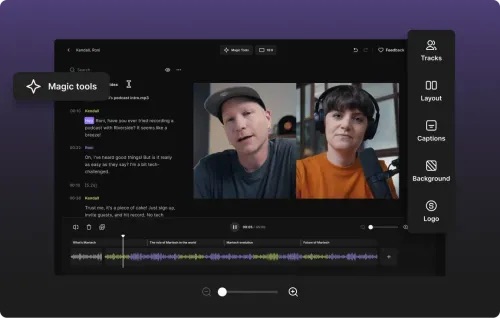
Then, Riverside scans its AI-generated transcripts of your recordings to find what single word you said more than any other (we’re assuming they cut out words like “and” or “the”).
In the podcast network’s Slack, we exchanged our Rewind videos. There’s something inherently funny about a video of people saying “umm” over and over. But we also know what these videos represent: our creative tools are becoming more saturated with AI features, many of which we do not want or need. The Riverside Rewind points to the uselessness of these tools themselves — why would I need a video of my co-host and I saying the word “book” over and over? It’s good for a quick laugh, but there’s no substance.
Though I enjoyed Riverside’s AI recap, its arrival comes at a time when my industry peers are losing opportunities to create, edit, and produce new podcasts, thanks to the same AI tools that generated our Rewind videos. But while AI allows us to automate away some tasks — like editing out our “umms” and dead air — podcasting itself is not that mechanical.
AI can quickly generate a transcript of my podcast, which is important for accessibility reasons, helping to automate an activity that used to be incredibly time-consuming and tedious. However, AI is not able to make editorial choices around how to maneuver audio or video to tell a story effectively. Unlike the human editors I work with, AI cannot determine when a tangential conversation in a podcast is funny and when it should be cut because it’s boring.
Despite the rise of personalized AI audio tools, like Google’s NotebookLM, its ability to serve as a creation tool has also seen high-profile failures, as of late.
Last week, The Washington Post started to roll out personalized, AI-generated podcasts about the news of the day.
You can see why this would seem like a “good” idea to profit-hungry execs — instead of paying a team to do the intensive work of researching, recording, editing, and distributing a daily show, you could automate it — except you can’t.
International